Guide to Yoga in India
Complete guide to everything you need to know about Yoga in India
THERE IS NOWHERE on earth like India to study Yoga, to take a Yoga Teacher Training course, or visit a Yoga retreat. If you have not been to India to study Yoga, you cannot possibly know or understand the depth or the truth of this ancient art and science. If you’re serious about it, sooner or later, you must experience Yoga in India. And this guide will help you with everything you need to know.
Yoga belongs to the world. But it has a home. India.
When I started Yoga classes in 1993, little did I know it would change my life. I soon found the benefits of Yoga to be enormous, on every level, and I eventually did a year-long Yoga Teacher Training program. In 2005, I travelled halfway across the world to study Yoga in India and stay at a Yoga ashram. I’ve been committed to Yoga ever since, and have spent a lot of time studying and practising Yoga in India.
This guide is intended to cover Yoga for beginners, everything you need to know about Yoga in India, including Yoga Teacher Training, ashrams, Yoga clothes, Hatha Yoga, Yin Yoga, Yoga retreats in India and much more. Plus, I will be adding to it regularly, and creating other Yoga guides – such as one specifically all about Rishikesh. So let’s answer all of your questions about Yoga in India, from my extensive personal experience. And you can always contact me by email if you have any questions (or via Facebook, Twitter, or Instagram).
Note: I would like to recognize the origins of Yoga as a school of Hinduism, an art and science that has been fostered from time immemorial in India. As someone who is not from this culture, I owe respect and gratitude to the Yoga teachers and traditions that I have learned and benefitted from. Pranam to all.
Popular questions about Yoga in India
- Where can I learn Yoga in India?
- What is Yoga?
- How is Yoga in India different than the west?
- How can I find out about Yoga for beginners in India?
- Is Yoga popular in India?
- Why study Yoga in India?
- Where can I learn Yoga in India?
- What are the best Yoga Teacher Training programs in India?
- What should I wear to do Yoga in India?
- What are Yoga ashrams in India like?
- Where did Yoga start in India?
- How do I apply for an Indian Visa to attend a Yoga course?

Coming Soon:
- Are there Yoga tours in India
- What is International Yoga Day
- What vaccinations do I need for India?
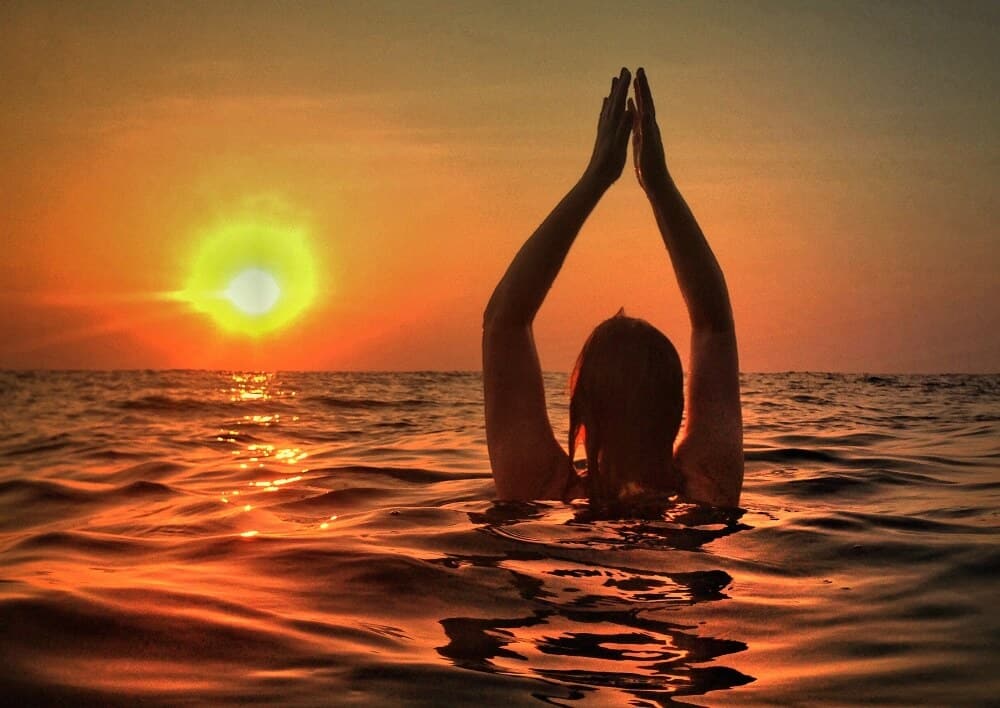
Mariellen in Yoga pose in the Arabian Ocean, Kerala
Why am I qualified to recommend Yoga?
I have been drawn to the wisdom of India since I was a teenager, and doing Transcendental Meditation, but didn’t start taking regular Yoga classes until 1993. I went twice a week to the YMCA in Toronto, where I was taught by a small-but-mighty Kundalini teacher named Simran, who hailed from Scotland. A few years later, after I experienced a series of devastating losses, I threw myself into Yoga to recover from depression, and religiously attended Bibi’s three classes per week for 10 years. In 2004, I completed a year-long Yoga Teacher Training program with Yoga Space in Toronto and became a certified Yoga Teacher.
Yoga was one of the main reasons I felt compelled to journey to India in 2005 for six months. I did a one-month Yoga intensive course at the Krishnamacharya Yoga Mandiram in Chennai, visited several ashrams throughout the country, and found my spiritual home at Aurovalley Ashram near Rishikesh in May 2006. Since that time, I have spent many months at Aurovalley Ashram, and also at Anand Prakash Ashram in Rishikesh, and I am devoted to this practise. Yoga is a huge part of my life – in fact, I live in Rishikesh, India, which is called the Yoga capital of the world.
If you are planning to travel in India, let us help you! We offer itinerary planning, India for Beginners custom tours, and much more to make sure your trip to India is filled with more magic … and less madness. Check out our Yoga, Spirituality, and Nature trip.
Studying Yoga in India was eye-opening to say the least. I realized that though I was deeply involved in Yoga in Canada, I was swimming in a pond. In India, I discovered the ocean. The Yoga ocean is a vast repository of wisdom and experience. And it’s not about being flexible. Yoga is so much more than what is generally presented or understood in the west; it is so much more than a system of exercises. It is way to self-realization, to peace, to increased consciousness and connection. In India, while studying Yoga, my mind opened up to ideas I never imagined. And this is a common experience for many people who make the journey to India for Yoga.
What is Yoga … and what it is not
Yoga is Sanskrit for union or yoke. It means to link, to connect. It is the experience of connecting to yourself and the nurturing source reality that you cannot be separated from. The purpose of Yoga is to still the mind so that you can experience this connection. Yoga is not actually something you do – you cannot “do” Yoga. Yoga is an understanding.
This may not sound exactly like what you are taught in Yoga classes and Yoga studios around the world. But as you proceed on your Yoga journey, you may find yourself wanting to try and understand the original intentions of yoga, without the overlay of western thinking, ideas, and culture.
Yoga strengthens the body, calms the mind, and softens the heart.
You may start doing Yoga with the idea of getting in shape, looking good in Yoga pants, or gaining more flexibility. You may invest in all kinds of Yoga clothes, props, and accessories, and may have an ideal or goal in mind – such as attempting to look like the cover of Yoga Journal.
But this is not Yoga. Yoga is not about achievement and it’s not about props. Yoga is not a systematic, linear process intended to get you somewhere. That is western dualistic thinking. Yoga comes from an ancient non-dualist tradition.
I like the way Yoga teacher Mark Whitwell explains it. “Yoga is intimate participation in the given reality, it’s the embrace of ordinary reality, the celebration of intimacy and attachment. It’s an interior process where you consciously breathe into your body and experience an intimate relationship with the marvel that is you.”
Yoga creates oneness within and harmony with nature.
T.K.V. Desikachar said, “The success of Yoga does not lie in the ability to perform postures but in how it positively changes the way we live our life and our relationships.”
Yoga is a conduit to joy
For Yoga, you just need a body and breath. Yoga is available at any time, to everyone. It doesn’t take money, skill, flexibility, special equipment. It’s an attitude adjustment more than anything else, and it just requires your breath and your attention.
Yogrishi Vishvketu said, “The essence of yoga is to bring freedom. And to believe and trust, to practice, and to help people to connect to their true nature of being fearless, blissful, joyful and playful.”
Comments
Post a Comment